
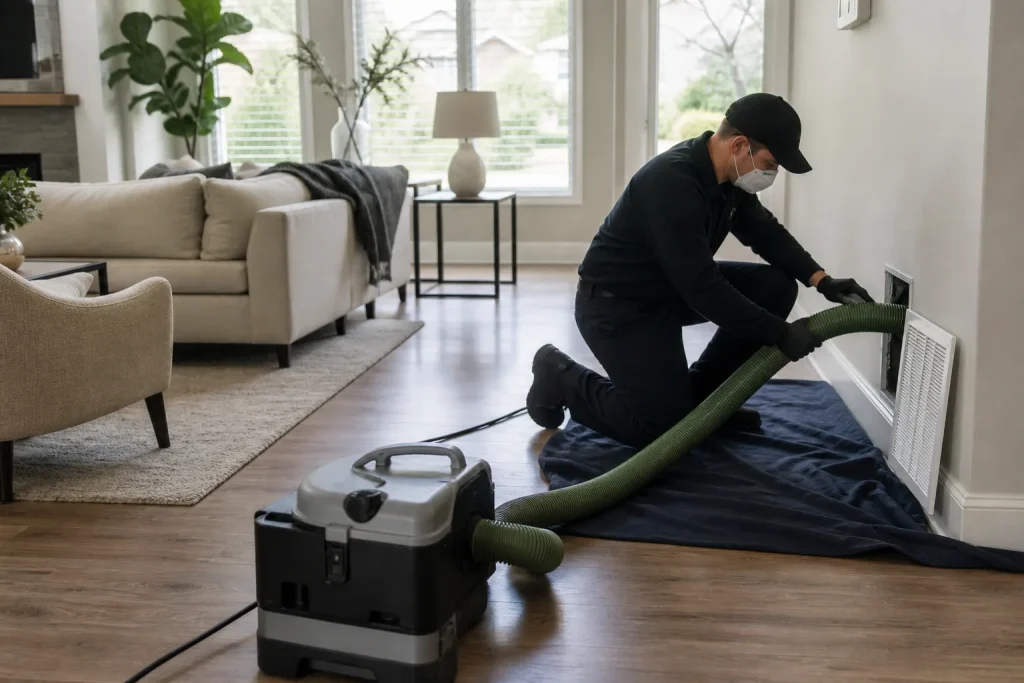
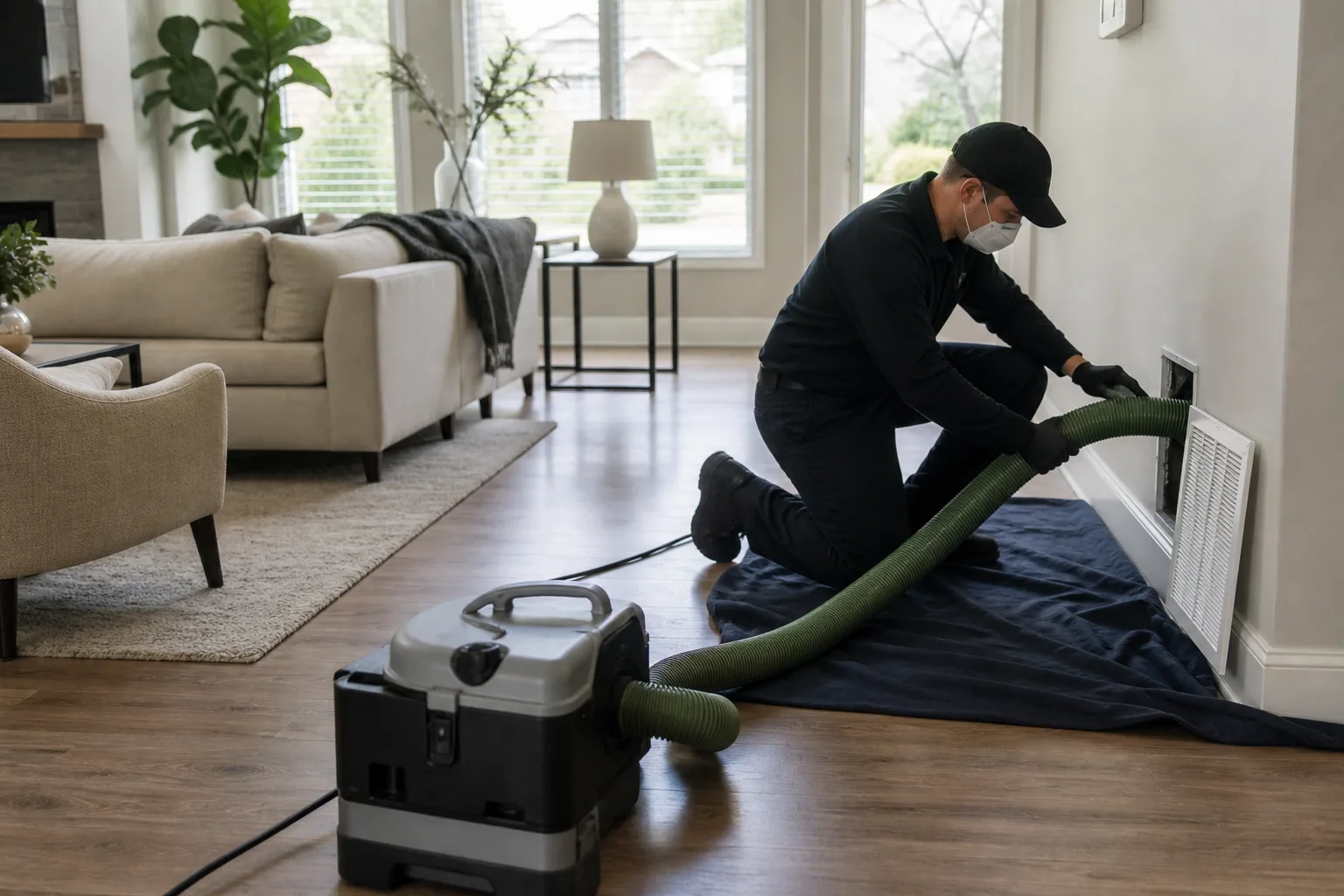
Emergency Air Duct Cleaning Near Me: What Arlington Homeowners Should Do First
Shut the system off first, then call. Turning your HVAC back on after a sewage backup, rodent discovery, or house fire is the fastest way to push contaminants into every room of the house, and we see it happen again and again while homeowners wait for a cleaning crew. Running contaminated air through the ducts doesn’t just make the smell worse. It deposits soot, spores, or pest waste into the trunk lines and every branch behind it, which turns a contained mess into a full-system remediation. Before you call anyone, contain the source.
If you’d rather hand the whole thing to someone who does this every week, call (844) 787-8766. We answer 24/7, and fast dispatch runs from 7am to 7pm, Sunday through Friday.
Key Takeaways
- Turn the system to OFF at the thermostat immediately after any contamination event.
- Don’t run the fan to “air things out.” It does the opposite.
- Cover return vents to stop passive air movement through the ducts.
- Photograph everything before you move or clean it, for insurance.
- Confirm the technician assesses the system before starting equipment.
Why turning the HVAC back on makes things worse
Your duct system is a loop. The return side pulls air out of living spaces, the air handler pushes it back through supply registers. When a contaminant gets into that loop, whether it’s sewage-tainted water, rodent droppings, or smoke residue, running the system distributes it evenly across every room. That’s the part that surprises people. A mess stays local while the system is off. It goes everywhere once the blower starts.
We’ve walked into Arlington homes where a small attic water intrusion got pushed through the whole house simply because someone wanted to see if the AC “still worked.” It did work. It also coated the inside of the ducts with moisture and particles that then needed a full professional cleaning instead of a spot treatment.
What to do in the first few minutes:
- Set the thermostat to OFF, not just fan-only.
- Switch off the air handler at the breaker if you can identify it safely.
- Close the registers in affected rooms if you can reach them.
- Don’t spray air fresheners or disinfectants into the vents. They mask the problem without fixing it and can complicate a later inspection.
This is the one passage in the article where the strongest advice is also the least glamorous: don’t touch anything you don’t have to. A calm, contained house is easier to remediate than a house where someone improvised.
The three real duct emergencies we see in Arlington
Arlington sits in the middle of North Texas, and the duct emergencies that show up here tend to fall into three categories. That’s useful to know, because the first steps differ for each one.
1. Storm-related water intrusion into attic ductwork
Spring storms in Arlington can push wind-driven rain through roof vents and attic penetrations. Flexible duct sitting in a wet attic absorbs moisture, and once insulation gets wet it stays wet. That’s a setup for microbial growth and, over time, for a duct system that smells musty every time the AC runs.
What to do: shut the system off, photograph the wet duct sections and any staining on the attic decking, and don’t run the system even on fan to “dry it out.” A wet duct that runs is a wet duct that sprays. A qualified technician should confirm whether the affected sections can be cleaned or need to be repaired or replaced. Our air duct cleaning service typically starts with that assessment.
2. Rodent nesting discovered during HVAC service
Rats and mice nest in duct insulation, and their droppings and urine carry real health risks. We’ve seen this often enough that it doesn’t shock us anymore, but it should get your attention. The problem is that the contamination is usually discovered by accident, during a routine HVAC visit or after the homeowner notices an odor.
What to do: shut the system off, don’t vacuum droppings with a household vacuum, and don’t try to bag and remove nesting material yourself. Contaminated ductwork needs professional containment, HEPA-level equipment, and cleaning methods suited to biological contaminants. Abatement Technologies equipment is one of the reasons we can take on jobs like this rather than decline them.
3. Smoke and fire events
Even a small kitchen fire or a nearby structure fire can push smoke into a home through the HVAC intake. Smoke residue is acidic and oily, and once it lands on duct surfaces it keeps off-gassing until it’s removed, not just wiped. Running the system after a fire event is the worst version of “let’s see if it’s fine.”
What to do: leave the system off, air out the home with windows and doors instead, document the damage for your insurer (more on that below), and schedule a professional assessment before anyone turns the system back on.
How to cover return vents the right way while the system is off
You want to stop passive air movement, not seal the house into a box. Warm air still moves through a home in Arlington even in mild months, and a return vent acts as a weak path between rooms when it’s open. Covering returns is a simple step most homeowners can take in ten minutes.
- Locate every return air grille. In a typical Arlington home they’re large wall or ceiling grilles, often in hallways and near the stair landing.
- Use a light plastic film or a piece of cardboard taped at the edges, not a heavy sealed cover. You’re slowing passage, not making a pressure vessel.
- Leave supply registers open, so no pressure difference builds up if the system runs unexpectedly.
- Take a photo of each covered return so you remember what you did and where. It also helps with insurance documentation.
- Don’t cover smoke detectors, CO alarms, or any vent the manufacturer labels as a combustion air intake.
One caution for Arlington homes with gas appliances: if your water heater or furnace draws combustion air from the same space, keep fresh air moving through that area. Sealing the whole house is not the goal.
What to expect when a legitimate emergency duct cleaning company arrives
A serious duct cleaner assesses before touching equipment. Walking in, plugging in a vacuum, and starting the job within three minutes is a red flag worth taking seriously. The assessment is what makes the rest of the work worth paying for.
Here’s what our technicians check on arrival, and what you should expect from any company you hire:
- Source of contamination. Is the water intrusion stopped? Is the pest problem addressed? Cleaning ducts while the source is still active is a wasted job.
- System layout. Trunk line size, branch count, access points, and whether the system is rigid metal, flex, or a mix. That determines the equipment used.
- Contaminant type. Water, biological, smoke, and construction dust each need a different approach and different PPE.
- Access and containment. Where they’ll create access cuts, and how they’ll keep contaminants from spreading during cleaning.
- Equipment. Rotary-brush systems like Rotobrush for scrubbing duct walls, and high-powered vacuum rigs like Nikro for pulling debris out of the system rather than just loosening it. If the technician can’t tell you what they’ll use and why, keep shopping.
- Repair scope. Worn, torn, or collapsed duct sections that should be repaired rather than cleaned. This is where we differ from companies that only clean.
If the assessor hands you a price before they’ve laid eyes on the system, walk away. Clean work starts with knowing what you’re cleaning.
Documenting for an insurance claim
Photograph everything before anyone touches it. That includes the source of the contamination, any staining on ceilings, walls, or attic decking, the return and supply vents in each affected room, and the thermostat setting at the time of the event. Insurance adjusters work from images and timelines, and once a crew moves things, the documentation opportunity is gone.
Preserve surfaces that indicate scope:
- Don’t wipe soot, mold, or staining before it’s photographed.
- Keep any damaged duct sections until an adjuster has seen them, unless they’re a hazard.
- Save receipts for anything you had to throw out, including soft goods and filters.
- Write down the order in which you noticed things. An adjuster asks, and precise answers help.
Where does duct cleaning fit into a remediation claim? It’s usually a line item inside a broader claim, alongside HVAC inspection, attic insulation replacement, and possible drywall or flooring work. Your written estimate from us can serve as one piece of that documentation. We can work with your insurer on the scope, though the final coverage decision is always theirs.
When to call a pro (and when to wait until morning)
Call now if the system is confirmed contaminated, if the contamination source is still active, if anyone in the household has asthma or a compromised immune system, or if smoke or sewage is involved. If the situation is a strange smell with no obvious cause, you can document it and schedule a regular assessment. Not everything is an emergency, and we’d rather tell you that than oversell a job.
A light bit of humor from our side of the phone: the most common “emergency” call we get is a strange smell after a new puppy, a new vacuum, and a new air freshener arrive in the same week. If the source is on the floor, the ducts are usually fine.
If you’re not sure whether your situation is a real emergency, call and describe it. We answer 24/7. A call outside dispatch hours is booked into the next opening, Sunday through Friday, 7am to 7pm.
Related services in Arlington: air duct cleaning is the starting point for most emergencies, and duct repair is what fixes the structural cause when a section has torn or collapsed. If a dryer vent is part of your concern, our dryer vent cleaning service addresses a genuine fire-safety risk on its own terms, not as an add-on.
The Bottom Line
For an Arlington homeowner facing a duct emergency, the sequence is simple: shut the system off, contain the source if you can, document everything, cover the return vents, then call a specialist. Skipping the first step is the one mistake that consistently turns a manageable cleanup into a full-system remediation. Once the pro arrives, expect a real assessment before any equipment gets plugged in. If the technician doesn’t examine the system first, that tells you what kind of job it’s going to be.
We don’t just clean, we repair, which matters because most contamination events start with a structural problem: a torn flex run, a gap at a boot, a collapsed section hidden above a ceiling. Rotobrush and Nikro equipment handle the cleaning, and Abatement Technologies gear gives us the range to handle contamination scenarios that a generalist can’t. Professional-grade equipment, every job, because clean ducts start with the right tools. That’s what we mean by being a benchmark rather than a baseline.
If you’re in Arlington and need help, Paragon Air Duct Cleaning offers free estimates. Call (844) 787-8766. We answer 24/7. Fast dispatch from 7am to 7pm, Sunday through Friday.
Frequently Asked Questions
No. Running the system pushes contaminants through every supply register in the house, which expands the job from a localized cleanup to a full duct remediation. Leave the thermostat off, switch off the air handler if you can, and cover the returns until a technician assesses the system.
Most emergency jobs take a half day or more, because the work starts with containment and an assessment before cleaning begins. Contamination type, system size, and access all affect the timeline. The written estimate sets the scope and the price, so you’ll know what the job involves before work starts.
Often a duct cleaning line is included when it’s part of a documented remediation claim, but coverage decisions belong to your insurer. Photograph everything before it’s touched, keep damaged materials until an adjuster has seen them, and have your written estimate ready as part of the file. We can work with your insurer as part of the claim documentation.
Yes, though we’ll ask that pets be kept in a room away from the work area while equipment is running. The noise and hose movement can stress animals. The cleaning itself is a routine job with a little disruption, not a household evacuation.
Then cleaning the ducts won’t hold. A wet duct, an active pest issue, or an ongoing smoke source will just recontaminate the system. Fix the source first, or ask your technician to help identify what’s still feeding the problem, and then clean.
Written by the team at Paragon Air Duct Cleaning.
Need Air Duct Cleaning Help?
Call Paragon Air Duct Cleaning - licensed & insured, here with fast help in Arlington.
(844) 787-8766